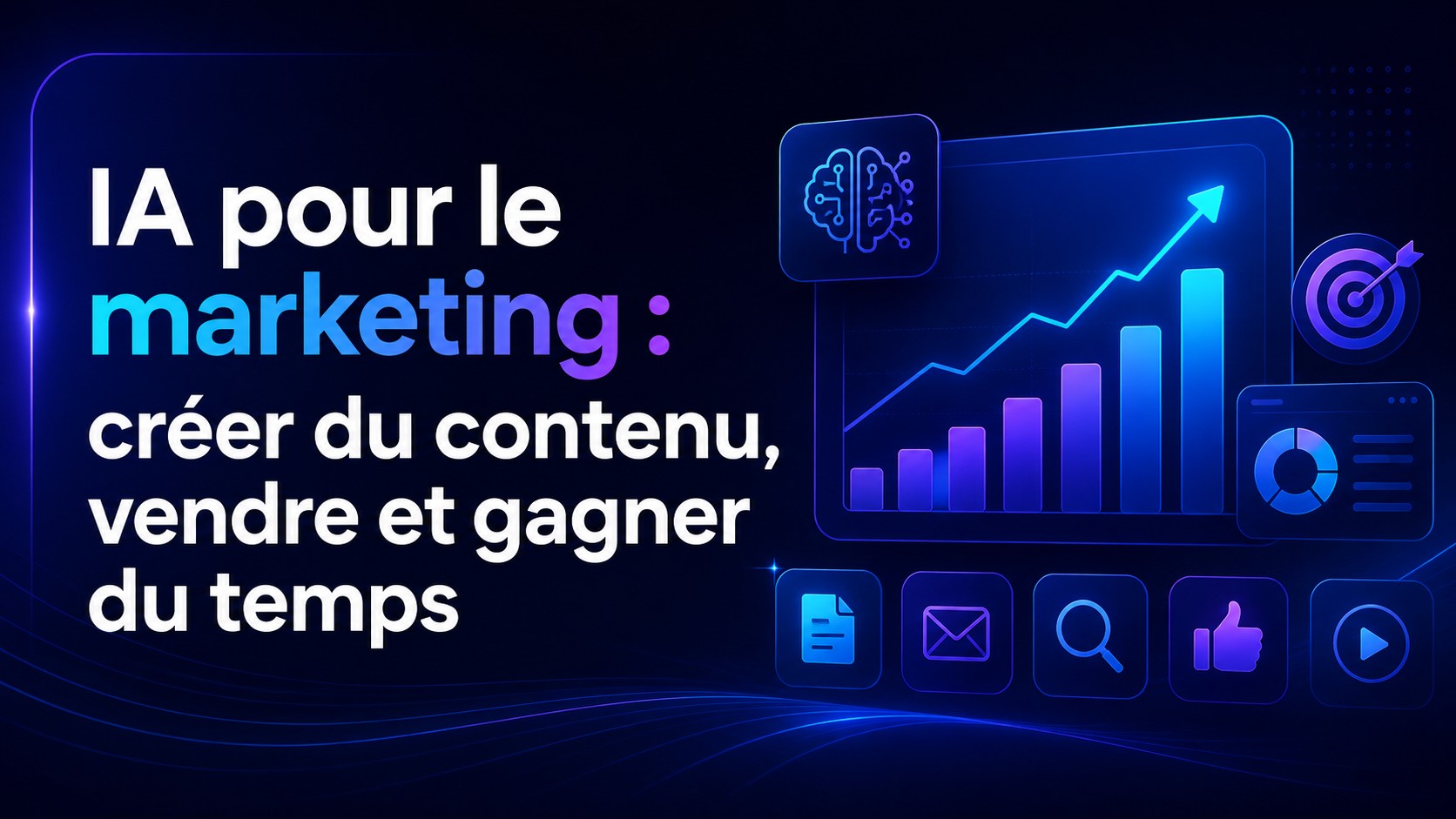
Why AI is becoming essential for marketing
Marketing teams manage ideas, content, campaigns, email, analysis and reporting. AI can accelerate preparation and reduce repetitive work, but strategy and brand judgment remain human responsibilities.
1. Find content ideas faster
AI can generate themes, questions, angles and content clusters based on a target audience.
Practical example
Turn one customer problem into a month of article, email and social-media ideas.
2. Draft marketing content
Use AI for first versions of articles, landing pages, posts, scripts and product descriptions.
Best practice
Add original examples, expertise and proof before publication.
3. Improve headlines, hooks and calls to action
Examples
Generate several headline variations and test them against a specific audience and objective.
4. Create marketing emails faster
AI can draft newsletters, onboarding messages, follow-ups and promotional sequences.
Practical example
Create three versions of the same offer for new users, active customers and former customers.
5. Automate part of prospecting
AI can research prospects, summarize companies and prepare personalized message drafts.
6. Create campaign visuals
Design tools can generate concepts, backgrounds, illustrations and ad variations.
Maintain consistency
Use brand guidelines and review every asset before publication.
7. Improve SEO with AI
AI can support keyword grouping, outlines, internal-link ideas and content updates.
SEO use case
Analyze a topic and create a structured brief before a writer produces the final article.
8. Analyze marketing results
AI can summarize campaign data and highlight unusual changes.
Practical example
Compare traffic, leads and conversion rates across channels and identify where performance changed.
9. Adapt one message to several audiences
AI can rewrite the same value proposition for different roles, industries or levels of expertise.
10. Compare marketing AI tools before paying
Evaluate output quality, integrations, pricing, collaboration and privacy with real campaign tasks.
Free or paid AI tools for marketing?
Free plans are useful for testing. Paid plans make sense when volume, quality, collaboration or automation creates measurable value.
Mistakes to avoid
Publishing generic content
Add expertise and differentiation.
Automating without strategy
Define the objective first.
Not measuring results
Track conversion, engagement and time saved.
Conclusion
AI can help marketers create, sell and analyze faster. The best results come from combining automation with clear positioning, original insight and measurement.
Create a documented marketing workflow
Define where AI is allowed to help: research, first drafts, variations, summaries and reporting. Also define where human approval is mandatory, especially for public claims, customer promises and sensitive targeting.
Use first-party knowledge
Provide brand guidelines, customer questions, product documentation and approved messages. AI performs better when it works from specific internal context instead of generic internet-style language.
Build content systems, not isolated posts
Organize topics into clusters, connect articles with internal links and reuse research across formats. A structured system produces more value than generating disconnected content.
Test before scaling
Compare AI-assisted content with the previous process. Measure production time, engagement, conversion and editing effort. Expand only when the result is clearly better.
Maintain originality
Add real examples, proprietary data, customer insight and expert opinion. These elements differentiate useful marketing content from generic AI output.